Umami, in its own terms
Umami describes itself as a privacy-first analytics platform covering traffic, campaigns, behaviour, conversions and revenue, with no cookies and no surveillance, self-hosted or in the cloud. It is MIT licensed, deploys with Docker, and runs on PostgreSQL. A managed cloud option is available for anyone who would rather not self-host, and individual visitor sessions can be viewed without identifying personal information.
Checked against github.com/umami-software/umami and docs.umami.is in august 2026. Products change; verify anything you are deciding on.
Where they actually differ
| Falorb | Umami | |
|---|---|---|
| Licence | MIT | MIT |
| Stores | ClickHouse and Postgres, with Redis between | PostgreSQL |
| To run it | Three services, more to operate | One service, simpler to operate |
| Unit of analysis | The person, resolved across properties | Sessions, per site |
| Cross-site identity | Same identify() id links your own products | Not a cross-property graph |
| Cookies | None required | None |
| Assistant access | MCP server, 25 tools | Not offered |
Which one you should actually use
- You want one container and one database, and nothing else to think about.
- Your traffic is modest and Postgres alone will comfortably hold it.
- You want the smaller, simpler codebase to read and modify.
- A managed cloud with published pricing matters to you today.
- You run several products and want them resolved into one audience.
- You want funnels with per-step drop-off and the people who abandoned.
- You want cohort retention, path analysis and revenue attribution built in.
- Event volume is high enough that a column store starts to matter.
The Falorb side, in the real interface
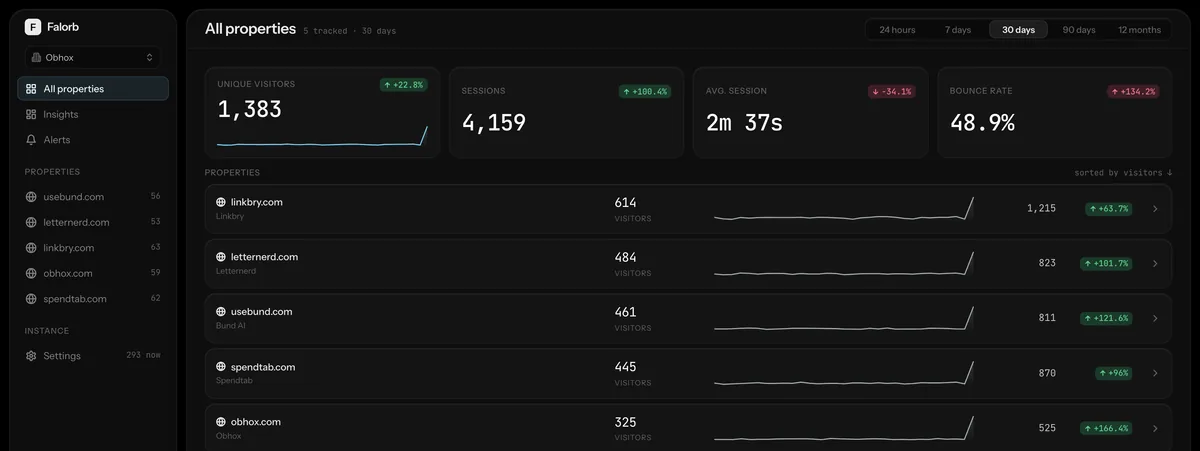
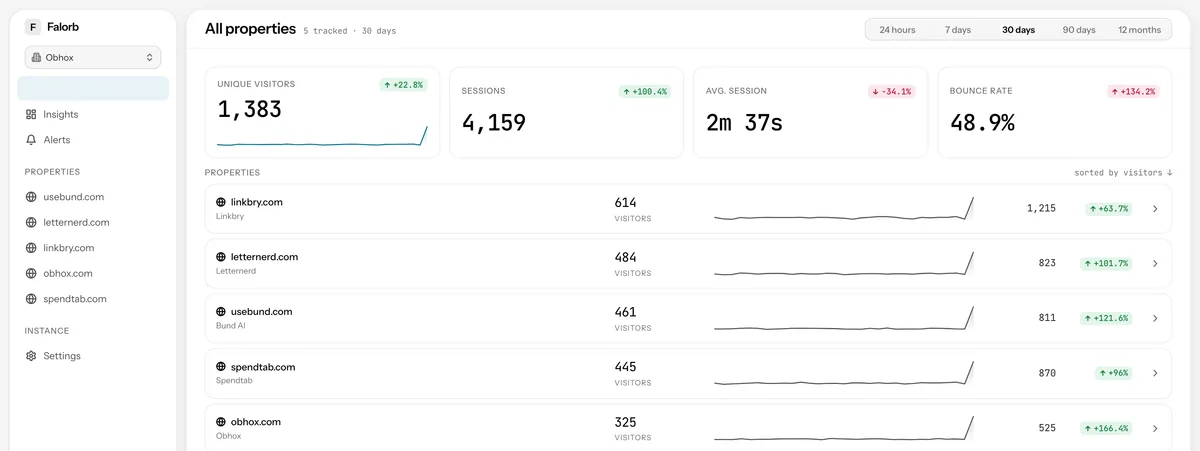
vs Umami: the usual questions
Is Falorb heavier to run than Umami?
Yes, plainly. Umami needs Postgres; Falorb needs Postgres, Redis and ClickHouse. That is three things to back up instead of one, and it buys column-store query performance and a person-level identity graph. If you do not need those, the extra operational surface is a cost with nothing on the other side of it.
Both are MIT. Is there any licensing difference?
No meaningful one. Both permit commercial use, modification and redistribution, and neither requires you to publish your changes.
Still deciding?
The fastest way to decide is to run it
Clone the repository, bring the stack up with Docker Compose and paste one script tag. Ten minutes, and no account anywhere.