Google Analytics, in its own terms
Google Analytics is the default web analytics platform, free at the tier almost everyone uses, deeply integrated with Google's advertising products, and processed on Google's infrastructure. Its scale and its integrations are real advantages, and no self-hosted tool replaces the advertising side of it.
Checked against Widely documented; verify current terms with Google directly in august 2026. Products change; verify anything you are deciding on.
Where they actually differ
| Falorb | Google Analytics | |
|---|---|---|
| Where data lives | Your servers, your database | Google's infrastructure |
| Licence | MIT, readable and forkable | Proprietary |
| Cost | Free; you pay for a server | Free at the common tier |
| Ad platform integration | None | Deep, and a real reason to stay |
| Raw event data | In your own tables, queryable | Via export, on their terms |
| Unit of analysis | The person, across every property | Events and sessions per property |
| Learning curve | Small; far fewer concepts | Substantial |
Which one you should actually use
- You buy Google ads and need conversion data flowing back into them.
- Your reporting, attribution or agency workflow is built on GA already.
- Nobody on the team can take on running a database.
- You need the integrations, not the analytics.
- You want the raw data in your own database, permanently.
- You run several sites and want one audience across them.
- You want a tool a new team member can understand the same afternoon.
- You would rather not send your visitors' behaviour to an ad company.
The Falorb side, in the real interface
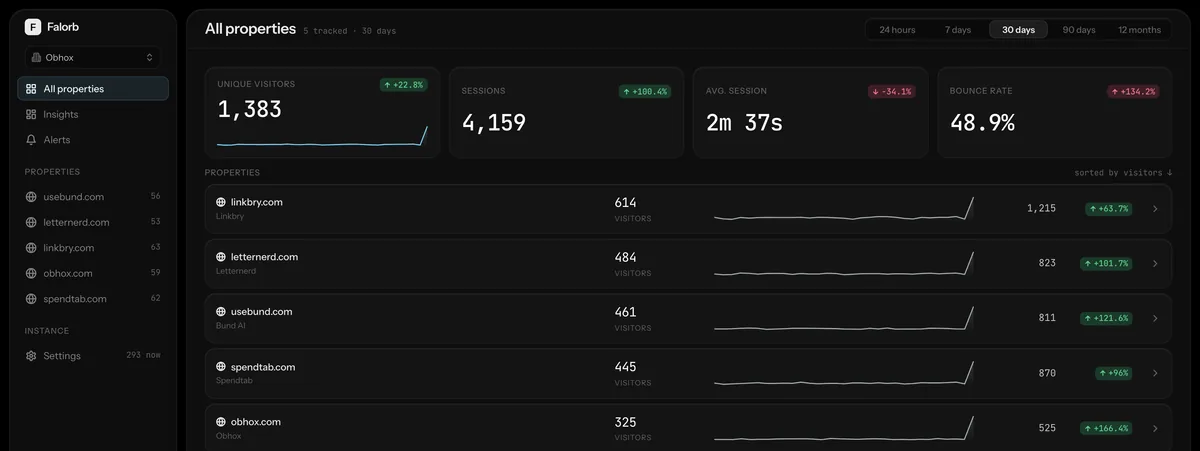
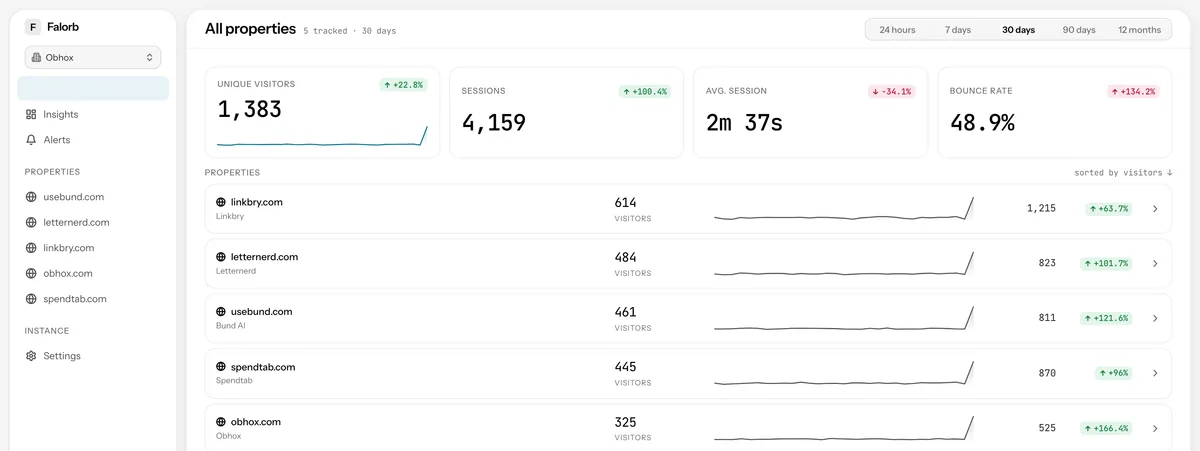
vs Google Analytics: the usual questions
Can I run both during a migration?
Yes, and it is the sensible way to do it. Both scripts can sit on the page together while you build confidence that the numbers line up. Expect them to disagree: different bot filtering, different session definitions and different consent handling mean two analytics tools essentially never report the same figure.
Will my historical Google Analytics data come across?
No. Falorb starts counting when you install it. You can export your Google Analytics history for your own records, but there is no import that would make it comparable, because the underlying definitions differ. Running both in parallel for a period is the practical way to bridge it.
Do I still need a cookie banner?
That depends on your jurisdiction and how you configure things, and it is not a question a vendor should answer for you. What is true technically: Falorb sets no third-party cookies, stores no raw IP addresses, and has a cookieless mode that persists nothing on the device at all.
Still deciding?
The fastest way to decide is to run it
Clone the repository, bring the stack up with Docker Compose and paste one script tag. Ten minutes, and no account anywhere.